COMMAND TRUTH = UNKNOWN
UNKNOWN
The command did not receive a confirmation.
UNKNOWN & reconciliation
The external system may apply a write even when its response never arrives. A timeout tells the caller that confirmation is missing; it does not prove that the change failed.
COMMAND TRUTH = UNKNOWN
The command did not receive a confirmation.
EXTERNAL RECONCILIATION VERDICT = MATCHED (derived)
A fresh, usable external observation agrees with the intended change.
If the first write already happened, repeating it can duplicate the side effect. The technical demo refuses a blind redispatch of an UNKNOWN command.
A conditional redispatch requires valid, active operator-confirmed configuration asserting both that the provider honors the same idempotency key and that repeating the operation is safe. The Framework records that operator assertion; it does not guarantee third-party behavior.
No universal exactly-once guarantee or guaranteed third-party idempotency is claimed. The demo's observed ledger count belongs to that controlled synthetic run.
Use a governed observation of the external object instead of interpreting a timeout as failure.
Freshness matters. Stale or unusable evidence cannot be counted as a match.
In the technical demo, an observation without a usable freshness window gives UNOBSERVABLE; a fresh matching observation gives MATCHED (derived). Command truth remains UNKNOWN.
Retain observations and audit records. Approval-task evidence-chain verification is scoped to that task, not the complete audit database.
Other conceptual verdicts are UNOBSERVED and DIVERGED. The public technical demo exercises UNOBSERVABLE and MATCHED (derived), not every vocabulary entry.
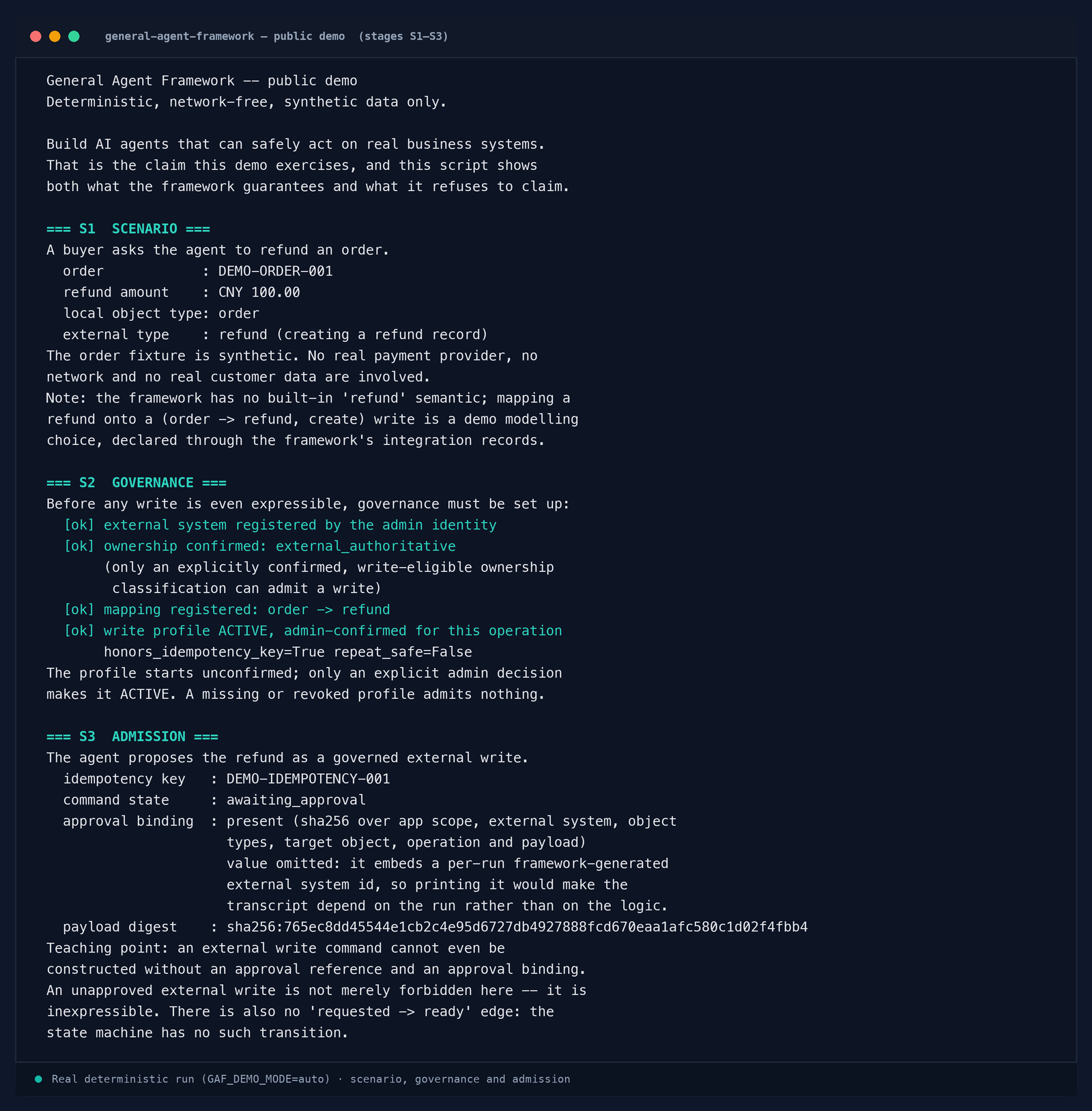
Separately licensed Framework-backed technical demo
A synthetic CNY 100 refund demonstrates approval, a write whose response is lost, refusal of blind retry and a fresh external-state match. Command truth remains UNKNOWN. No live business system is contacted; approval is a DEMO HUMAN APPROVAL SIMULATION.
This technical demo substitutes only the transport; governance and execution behavior above it belongs to the licensed Framework. Re-running requires the private, separately licensed Framework. The manufacturing public simulation does not share that execution-proof scope.
Read the public reconciliation document · See the manufacturing simulation snapshot